
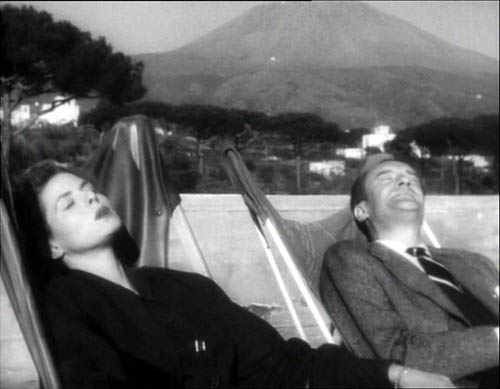
 Michelangelo Antonioni is safe now in heaven, perched high above his rabid critics and his cultish followers alike, looking down at us, probably, with the same combination of Christ-like love and God-like omniscience that made his films so beautiful yet so devastatingly honest. In this still, from 1960's groundbreaking L'avventura, Monica Vitti looks down from the cliffs of a tiny volcanic island into the sea which, just like his characters, remains forever changing yet always the same. In it, she might see a reflection of her inner anguish, or a symbol of life's impermanence, or who knows what other meaningful similitudes. Michelangelo Antonioni never gave us too many answers, and of course his general appeal suffered as a consequence, but it's hard to argue against his work in retrospect. In Flickers, Gilbert Adair's love letter to the first century of film, we are told that American audiences don't want to see two things: subtitles or subtleties. Unfortunately for them Antonioni delivers both, with little need for much of the first and a career-long elevation of the second, and yet it was at Cannes - and before a mostly European audience - that he was famously booed out of the theater during L'avventura's initial screening. Later that week justice would be served when at the demand of his fellow artists he was awarded the special Jury Prize (that year's competition included work by Tchoukhrai, Minnelli, Bergman, Ichikawa, Fellini, Dassin, Ray, Bunuel and on and on...) and cinema suddenly appeared to have found it's most modern voice: a voice that had it's predecessors to be sure (most directly Rossellini) but that left its indelible stamp on a far greater number of artists who followed in his footsteps, and mostly walked forever in his shadow. I still remember learning of Antonioni's death - which at 94 and unable to speak or walk following a debilitating stroke should probably have come as no great surprise -and the terrible, hollow feeling of loss that set in almost immediately. The problem with the pain of true loss is that, unlike whatever it replaces, it never goes away: on the contrary it slowly eats at everything else until one no longer hopes for better or tries for more, and instead simply accepts the feeling as a condition of his existence. And yet how else could it be, with Michelangelo Antonioni? What other feeling should we expect to encounter when dealing with the greatest filmmaker of the nuclear age than ennui, a word whose meaning I might never have learned were it not for him. A word that pops up ubiquitously in his film's reviews. A word for which, after having been illustrated again and again for us by Antonioni with such clarity, no subtitle is necessary.



2 years ago